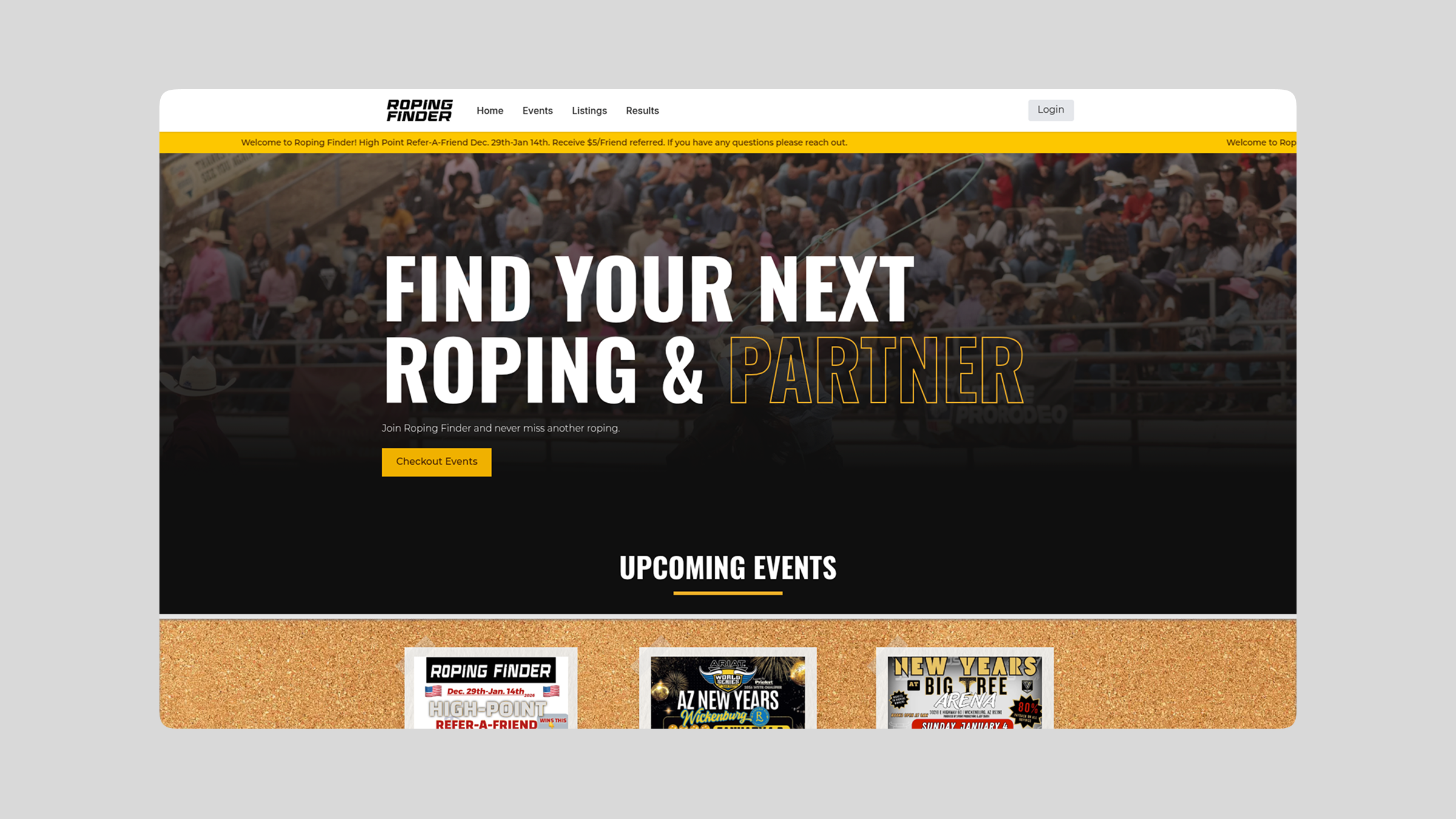
Building Roping Finder
RopingFinder started when someone approached me with a simple idea: build a better way for team ropers to find events and partners to rope with.
Before this, everything lived in scattered Facebook groups. Events were easy to miss, posts disappeared in the feed, and if you were looking for a roping partner that matched your skill level or location, it was mostly luck and timing.
The goal was to replace that mess with one clear system where people could find events, connect with each other, and stay in the loop.
What I built
I built RopingFinder as a small product, not just a website.
There’s a public side where anyone can see what’s coming up, and a member side where subscribed users can access the full event list, filter by state, switch between list and calendar views, and see everything in one place.
On the homepage, non-subscribed users see the next three upcoming events. If the admin flags events as “featured,” those are shown instead. This gives visitors useful information right away, while still giving the product a reason to exist beyond being another static event list.
When someone subscribes, they unlock the full system.
Subscriptions and payments
We started with a $7.77/month subscription. Later, the client wanted to offer a $90/year option, so I added that as well.
Stripe handles all of the billing, access control, and subscription status. Inside the admin area, the client can see who is subscribed, who is signed up for updates, and export lists of users when needed.
This means he owns his audience and his data, instead of it being trapped inside a social platform.
Communication and audience tools
We added the ability to export users who are subscribed to updates so the client can communicate directly with them.
Right now I’m in the process of wiring up Twilio, Resend, and ConvertKit so he can send announcements, updates, and reminders without doing everything manually. The idea is to give him a simple communication layer that fits naturally into how he already runs his business.
Designing for a non-technical audience
The rodeo crowd isn’t especially tech-savvy, so a big part of this project was making sure the app felt obvious to use.
No complicated dashboards. No buried features. Just clear navigation, simple filters, and layouts that make sense on a phone.
Most users just want to answer two questions quickly:
What events are happening near me?
Is there someone I can rope with?
Everything in the UI is built around making those answers easy to find.
Why this project matters to me
This project is a good example of how I like to work.
Not by throwing together pages, but by building a system that replaces a broken process. Something that handles users, payments, data, and communication in one place, and quietly makes a business easier to run.
RopingFinder isn’t a demo or a concept. It’s a real product with real users, real subscriptions, and real operational needs, and I’ve been responsible for designing, building, and evolving the entire thing.
That’s the kind of work I care about.